Showing posts with label grooming tip tuesday. Show all posts

Tuesday, October 25, 2011

Grooming Tip Tuesday - Bathing and Hot toweling

Grooming Tip Tuesday - Bathing and Hot toweling


Bathing is useful in several situations. Getting ready for a show or after coming in from the field when the horse is extra dirty are just two reasons. Before I start discussing the WHY and HOWs of bathing, I need to note that if you give your horse a bath frequently it will dry your horses coat out and make him more dull, rather than shiny and clean. There is no substitute for a good, thorough grooming.

WHY bathe?
  • Extra clean for showing
  • Good when first starting to groom a horse to get rid of all the nasty scurf and dander that has built up on the coat
  • Remove stains and dirty spots on coat, especially on a light horse
TOOLS needed
  • Buckets of warm water
  • Shampoo of your choice (use horse shampoo, not people shampoo)
  • Body sponge
  • Rubber curry comb (or jelly scrubber)
  • Sweat scraper
  • Towels or cooler if appropriate
HOW to bathe
  • It's easiest to rinse horse off with hose, but if you don't have access to a hose with warm water, sponge off entire body getting the horse throughly damp. Start at the hooves then work your way up to the legs then body. I start at the front of the horse as well and work back to the hindquarters.
  • Don't forget to wet the mane and tail!
  • Squirt a bit of shampoo into your bucket and make sudsy. Sponge this over the horse. Don't be afraid to use a lot. The horse should be pretty sudsy. 
  • Use the curry comb or jelly scrubber to loose up dirt and work shampoo into a lather
  • When shampooing the mane and tail, I tend to use my fingers because I've found that works best. Hey, it works on our hair doesn't it? Pay attention to the base of the tail (super dandruff-y) and the base of the mane. Don't apply conditioner to the mane or tail if they are going to be braided in the near future. It doesn't end well!
  • Rinse before moving on to a different section of the horse. It should feel super clean and free of shampoo. You can either rinse with a hose or by squeezing clean water onto horse with a sponge
  • Shampoo left on the coat is never a good thing. It makes horses itchy and leaves them sticky, gross and often looking less shiny then when you started. Not ideal.
  • When shampooing the horses face, use as little as soap as possible. Most horses don't like this and I've found baby wipes or hot toweling works better. If your horse allows you to bathe its face, then go right ahead. Just proceed with caution.
  • White/light coats should use a shampoo afterwards like Quik Silver. Apply full strength and let sit for 5 to 10 minutes. Rinse afterwards. Repeat as necessary.
  • Make sure you use a sweat scraper afterwards to remove all excess water. Use a dry sponge or towels to remove water from legs and face.
  • If it's cool out, cover horse in a cooler unless they're totally dry. 
  • Don't leave unattended. They WILL ROLL! :)

Hot Toweling

Hot toweling an be used in cold weather when bathing isn't an option or if you're aren't allowed to give a horse a bath for whatever reason. It works really well on getting up the dirt and scurf from those problem areas like the mane, head and croup. You need a bucket of very hot water (the hotter the better!), rubber gloves if you prefer to not burn your hands and a large towel. If you have gloves, put them on first. Dunk the towel into the bucket full of hot water and wring it out until it's almost dry. Rub the towel with one hand into the roots of the coat. The towel should be dry enough to not wet the hair but bring up all the dirt. Continue to move towel around in your hand to clean spots. When the towel gets cooler, place it in the bucket again and repeat. You can hot towel any part of the horses body as long as they are comfortable with you touching it.


If you have any questions, comments or a suggestion for a grooming tip tuesday post, please comment and let me know! :)

Wednesday, October 12, 2011

Grooming Tip Tuesday - White coronets, socks and stocking! Oh my!

(Apparently, the "auto post" option that I tried yesterday did not work... oops.)

White coronets, socks and stockings! Oh My!


This week it's all about the down and dirty on getting those whites CLEAN. My first step is always to shampoo them. I don't need to use a blueing shampoo, like Quik Silver, the first time around. I lather them up and scrub, scrub, scrub. If they're covered in super gross mud and dirt, they simply aren't going to get sparkling white. The next step is to rinse, let dry and then clip. I tend to use a 10 blade but you can also use a smaller blade, like a 15, if you prefer the closer clip. Be careful with a smaller blade that you don't leave clip lines! It's pretty easy to do if you're using anything above a 10 blade. I clip the entire white, whether this is just around the coronet or all the way up to the knees. After clipping, it will be much easier to keep those whites white! For basis maintenance, just keep up to date on shampooing when they get gross so the whites don't have the chance to stain in the first place.

For a show or any other important event that requires lots of flashy whites, I do the same first steps (shampoo, let dry, then clip) a day or two ahead of time. The day before the event, I shampoo with a blueing shampoo like Quik Silver. Make sure you don't dilute Quik Silver. Apply directly to the white and scrub. It needs to sit for about 5 minutes. If it sits too long, it has the chance of staining the white purple. Eek! But if it doesn't sit long enough, it doesn't get as white. After shampooing and washing out the shampoo, I do one of two things. If it's only a tiny coronet on front leg or on a generally clean horse, I usually just spray some ShowSheen to help repel stains and dust and call it a day. If it's a sock or a stocking, I apply baby powder or corn starch while the leg is still wet from the shampooing. Pack as much in the white as you can! Honestly. You almost can't use too much! I don't apply ShowSheen after the baby powder but that's just me. On the morning of the big day, brush out any baby powder/corn starch that is still in the white marking and admire. I usually apply ShowSheen on the white marking after knocking out the baby powder/corn starch just to be safe but it's not necessary. The whites NEVER get whiter than a good course of clipping, Quik Silver and baby powder! (Note: you can do this to an entire body, or to any white marking on the body, but it does require a lot of baby powder!)

If possible, wrapping and blanketing is always your best option before a show day. White legs stay much cleaner by default when they have wraps on!

Tuesday, September 27, 2011

Grooming Tip Tuesday - Basic Grooming Procedure

I went over all the grooming tools last week. This week I'm going to describe a basic grooming. I've found this is best after exercise, when the horse is relaxed and a little tired. If you're riding the horse, I pull him out of his stall and start with light brushing. I just get the majority of the dirt off with a plain black rubber curry followed up by a hard brush in the areas that will be affected by tack or leg protection. After the ride when the horse is fully cooled, put the horse back in his stall and let him hang out, chew on some hay and get a drink while you clean tack and put everything away.

With yearlings to start, I use a mane and tail brush. We brush our yearling manes and tails every day and they are kept completely tangle free. On a regular horse, I start with the curry comb. This is probably the most important step to getting your horse clean and shiny. Currying loosens up all the dirt and dander and gives the horse a nice massage. I tend to use a lot of different curries for different purposes. I generally start with a black rubber curry type and use it in a circular or side to side motion all over the horses body. It depends on the horse though. Some horses need softer curries, while others can tolerate hard curries. Always use a rubber mitt or special face curry on the legs or face. If the horse is extra sweaty and you're unable to bathe or hose off, using wintergreen rubbing alcohol on a towel will remove all the dirt from that area. I try not to use alcohol regularly because I feel like it would dry out the coat. If the sweat has dried already, using one of the plastic Shed Flowers in a circular motion works well. If the horse is shedding a lot, the Grooma Grooma can be used now to lift all the loose hair off. In certain severe circumstances, I will use a dry microfiber or hand towel after currying. It helps pick up a lot of the gross dirt and dander you just lifted that sometimes just refuses to be brushed off the coat any other way. Curries also need to be check every few weeks or months depending on how many you groom a day to make sure the rubber has not worn down too far. A curry that is worn will not clean nearly as effectively.

Next, use a hard/dandy brush. Grooming is a vigorous process! When using the hard brush, use short, flicking strokes. There should be dirt flying off your horse. If it isn't, you either didn't curry enough to lift the dirt or you aren't brushing hard enough. Use the hard brush in the direction of the hair growth all over the body. Keep listening to your horse because some tolerate this better than others. Digby hates being hard brushed but most of the yearlings I groom actually seem to enjoy this part. Use the hard brush on legs and face if the horse tolerates it but with lighter strokes then on the body. Like I said before, don't forget key areas like the elbows, pasterns and base of mane.

Next, use a body brush in the direction of the hair growth. This is a very important step. This brush will pick up all the dander and dirt that was lifted by the curry and what's left over from the hard brush. Your brush WILL get dirty quickly if you're grooming correctly so make sure you clean it by wiping it on a towel or using a metal curry every few strokes. This brush can be used on any body part, including the legs and face. I try to avoid using it on the legs because they tend to get pretty clean with the hard brush only. The body brush is also good for that oh so hard to banish dust/dirt on the top of their hindquarters. If you need to keep your grooming tools budget to a minimum, buying a high quality body brush will benefit you best in the long run out of any other grooming tool.

Use a sponge, warm damp towel or baby wipes next to clean out ears, nose and around the eyes. I occasionally use a baby wipe to clean their bridle path if it just didn't seem to get clean while brushing. Use another towel or sponge to clean behind the tail and near the sheath or udder.

I generally will use the mane and tail brush now. I don't brush out the tails on riding horses often. I think leaving them alone tends to make them the thickest and longest. I will brush out forelocks and manes though. Use a silicone spray (Show Sheen, etc) to detangle if you do not have time to pick out the knots by hand. Whatever method you use, you need to be careful not to break hairs. Manes and tails take a looong time to grow in! After that, I hoof pick. I won't go into details about hoof picking because it is fairly straight forward. Refer to the USPC Manual if you have questions about hoof picking.

As a finishing touch, I rub the horse down with a hand towel. You can also use your hands as the oils from your skin help the horses coat. I use white towels so I can see if there was any dirt left. I do not necessarily use the same towel on the same horse every day. When it's dirty, I launder it. I know people who use the same towel after every grooming on the same horse, every day. The towel helps distribute the oils back onto the coat. It definitely works but I think using a new, clean towel works fine as well. Use the towel in circular motions, ending with brushing the hair in the correct direction. Rub the horse for as long as you have time, as this toweling really helps get them shiny.

That's all for this week! If you have any questions or comments, please leave them for me! I'll be gone for work until the 8th so there won't be a grooming tip tuesday next week, nor will you be hearing any Digby updates. :( I promise to update you as soon as I get back!

Tuesday, September 20, 2011

Grooming Tip Tuesday - Tools of the Trade

Grooming Tip Tuesday! Tools of the Trade

Before I get into the basics of grooming, I'm going to discuss what brushes I personally use. It's in no particular order, as I'll get into that next week. Again, this is just what I use so by all means test them out on your own horses. Different horses prefer different types of brushes depending on their coat types and if they are thin skinned or not. Grooming should take about 30 minutes. 45 minutes is actually the best but it's a bit unrealistic for the normal person who would probably like to ride, as well as groom their horse in their limited time schedule. You're going to want some container to keep all your brushes in. If you like to see all your items, a grooming tote works best. If you have a place to spread your brushes out, you can use a simple bucket. A grooming bag is also an option. They usually have lots of pockets to keep things semi organized.

Curry Combs


Depending on what kind of horse you have, their coat, and how thin skinned they are, the currys you use will vary. Curry combs are used to loosen up dirt and dandruff and provide the horses skin and muscles with a massage. I use a variety of curries for a variety of different things.


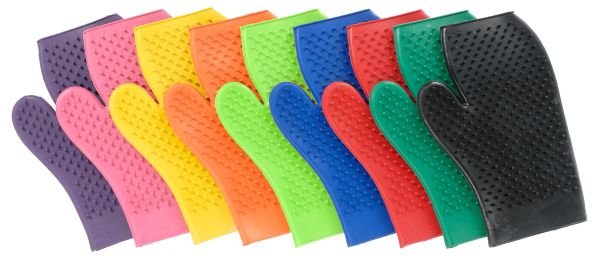
I use a rubber grooming mitt for more sensitive areas like the legs and face, if the horse allows. They're good for shedding and getting off dirt in areas where a horse does not tolerate a normal curry.

I use a plain black rubber curry for general body currying. These are semi flexible and work best with "shark" teeth rather than rounded edges.

I've found that the "grooma groomer" works best for getting up loose hair on horses that are shedding. Most horses really enjoy when you use this on their muscles after exercising hard.

Two of my new favorite curries are the Epona Shed Flower and the Epona Curry Flower. The shed flower works really well on sweat stains (remember some of us can't bathe the horses we're grooming and need to get rid of sweat) and the curry flower works well on really dandruff-y skin. They might be silly because they're in flower shape but they both work well... so I'll over look it.


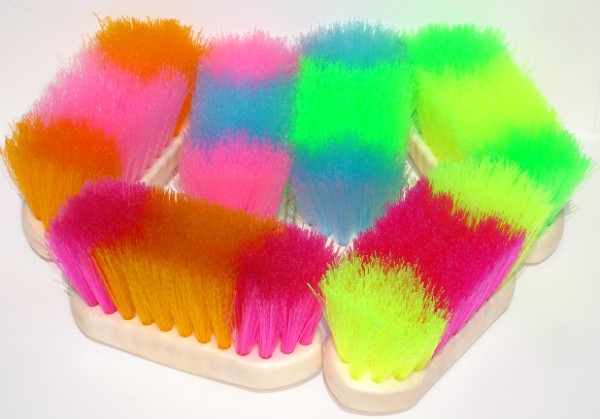
Hard/Dandy/Stiff brush


I like both synthetic and natural brushes for these. Natural brushes make them shinier in my opinion but if you're buying them yourself, synthetic brushes are often $3 versus $20 for a natural brush. It's up to you. Hard brushes are used in short flicking motion, to lift the dust from the coat. Use very hard and short strokes. You should see dust flying off your horse! You can use these all over except generally the face. Make sure you get the base of the mane and pasterns. These are often overlooked parts and all very important!

Medium/Body brush


This is used to remove all the dirt and dust you just lifted from the coat by currying and the hard brush. The brush should get very dirty quickly as its taking all the dirt and dander from the horses coat. Clean it often by wiping it with a towel or by using a metal curry. Brush horse all over in the direction of the hair growth.

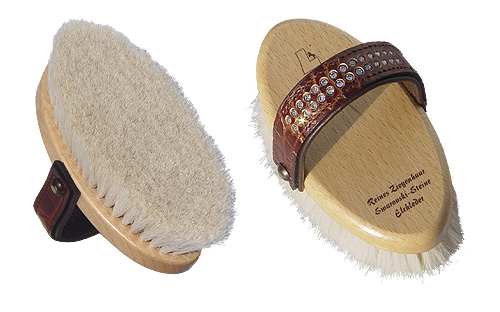
Soft/Finishing Brush


Not entirely necessary but I like using a very soft brush to follow up. I just think it gets the last little bit of dirt up from the coat for a final "polishing". They tend to be made of goat hair or some other super soft material. Use the same way as the medium brush.

Mane and Tail Combs


These can be combs or brushes. The key is to not pull out any hairs. Which ever you prefer, start from the bottom of the mane or tail and work your way up. Detangler (ShowSheen, Vetrolin, Mane and Tail, and Cowboy Magic all make their own detanglers) can be added if you're short on time (like me) or patience. In theory, manes and tails should be worked out by hand but honestly, who has time for that? Pulling combs should be used for pulling only in my opinion but I know people that use them as combs as well.

Hoof Pick


Used for, well, picking out hooves. Remove all dirt and make sure there are no rocks/foreign objects lodged in their shoes. I'm a big fan of the cheap 89 cent hoof pick. There are plenty of fancy, schmancy hoof picks but honestly the cheap ones work just fine. Why waste your money? A hoof pick with a brush is very nice to have and still cheap.

Extras


Other things you may want to have around are:
- Scissors (for quick cutting of fetlocks or bridle paths)
- Unscented baby wipes (great for noses, ears and those who dislike their face being brushed... Ahem DIGBY!)
- Towels (We used normal small hand towel sized ones that we buy in bulk at Costco at work. Digby gets microfiber towels that I got from the car parts store. Works well for a rub down and final polish after brushing)
- Baby powder/corn starch (works excellent in getting those white markings blindingly white! Add to marking when it's still wet from being bathed and brush out once dry)
- Blueing shampoo/Quik Silver (a must have for white socks or stockings!)
- Any shampooing items you find necessary (Bathing will dull a coat if you do it often so keep bathing to a minimum. Trust me, your horse will thank you and they can be just as clean without a bath as they can with one if you work at it!)
- Steel wool or brillo pads (work well instead of paying for an expensive hoof brush to remove dirt and other "grossness" from hooves)
- A&D ointment (works wonders on healed cuts to help grow hair back. Do not use on any wounds that have not healed yet)

Recommending Reading


The United States Pony Club Manual 

Braiding Manes and Tails

Grooming

Grooming to Win (the best book for discipline specific answers)

Tuesday, September 13, 2011

Grooming Tip Tuesday

(Hey guys! This is the first installment of the "mini series" that I talked about. Hopefully it will be a regular occurrence every Tuesday until I run out of things to discuss. If you have any questions, comments, tips, whatever just let me know in the comments and I'll be sure to discuss it or answer them!)

Nutrition and General Health
I debated discussing this but I decided that it's so important I needed to. Horse nutrition is a HUGE topic in which I have no real scientific knowledge or education. Google it, look it up on the Chronicle forums, ask around, whatever. There is a ton of varying opinions of feed this, feed that, don't feed that because the horse may dieee *cue fake dramatic shriek of horror*.

A happy, healthy horse always looks the best. Horses are meant to move and graze 24/7. Very often, especially in this area of the US, do horses live outside 24/7 in an area that they receive the type of lifestyle their wild ancestors had. I believe (and this is strictly opinion) that all horses should be kept up to date on any vaccinations that are recommended by a respected, knowledgeable veterinarian in that area. All horses should be given dewormer at the recommended dose at the correct time. Teeth should be taken care of as well by a vet or equine dentist. Horses should be conditioned and worked correctly, to help build up proper muscles so they can be happy doing their job at the highest level. They should be turned out as much as possible. The farrier should be out to trim or reset shoes every 4-8 weeks depending on the time of year and the horse. Above you, you need to listen to your horse. A fat or super skinny horse isn't going to look as nice as a well conditioned one in proper weight, no matter what the coat looks like.

High quality hay is always the start of good nutrition. It keeps horses happier, busier, and is very well suited for the grazing 24/7 lifestyle. If you horse needs extra calories, then start including grain. Tons and tons of grain does not create a high show bloom. That said, while prepping yearlings at work, we strictly limit their hay intake to avoid "hay bellies" and give several pounds of grain a day. It works. But these are yearlings on a strict feed regime, a strict exercise regime and closely monitored every single day to prevent OCDs, create a high shine coat and make them manageable. This is only their lifestyle for two to three months while they were in the barns for preparation for sales. It is NOT a long term feeding plan. All horses should have access to clean, fresh water at all times and I'm a personal fan of salt blocks. Buy the highest quality hay and grain you can buy and you should be fine in that catergory. If you have questions, ask your trainer, your vet, the barn manager or a knowledgeable friend.

Nutrition matters. The yearlings come in on one type of feed (I won't name names just in case) and we have a 7 day period that we switch them over to a new, higher quality feed. From our daily 30 minute grooming and the new feed, the horses look phenomenal when they leave for the sales. It's only a few months time span. The fat ones who get less feed usually have worse coats that we have to groom that much harder to make shiny. Coincidence? I'm not sure. That's for you to decide.

Be careful to provide the horse with the recommended amount of protein, vitamins and minerals for the age and workload. If you don't meet the recommended feeding amount on the back or tag of your feed bag, you may want to consider switching feeds or supplementing with a vitamin/mineral product (think Centrums for horses!) or a ration balancer. Many feed companies have ration balancers. Speak with your vet, knowledgeable person, etc etc or a feed specialist from the company you use if you have questions. (FYI - The difference between a vit/min supplement and a ration balancer is that a ration balancer contains protein as well as vit/min. Both are low calorie which is great for those chubby horses, though the vit/min supplements tend to be lower if you have a super easy keeper.)

Supplement and product wise, there's a TON out there. I've heard many, many reviews on this supplement or this spray or whatever. As a short term fix, yes products work. Showsheen DOES make them shiny for a day. Healthy Hair Care does make them shiny. I'm sure lots of other spray on products do as well. I just don't have the time or energy to list all the ones I've used or heard about. I've heard tons of good things about Omega Horseshine, SmartShine, and personally I've noticed a different since Digby's been on the Smart Omega3 to help with his lameness which isn't supposed to be for coats/shine but it has a lot of Omega 3s (hence the name) which help with shine. There are lots of options out there. I attended a lecture while I was in school given by a miniature horse breeder and winner of several national in hand competitions who swore up and down about feeding sunflower seeds for shine. Flax seed and linseed are also really popular at the moment. Honestly, while I think it probably helps, elbow grease is free. If you have a high quality feed and hay, you should have a healthy horse. A healthy horse is a shiny horse!

Even in poor, low lighting Fashion Gabby is a shiny colt! This is with NO spray on products or feed thru supplements to his feed. Nutrition matters! :)